

CNN Pushes Trump to Negotiate with Powerless Iranian President #Political
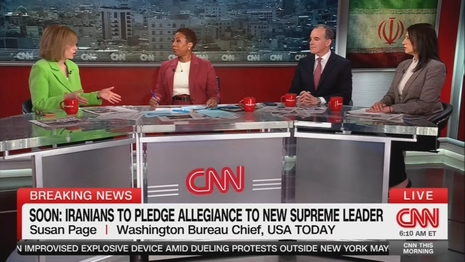 During Monday’s CNN This Morning, panelist Susan Page of USA Today suggested President Trump missed an opportunity to negotiate with Iran after President Masoud Pezeshkian made a video statement on Saturday as a pledge to Gulf countries that they would stop attacks against them.
Spoiler alert: the attacks against gulf countries had not stopped since Pezeshkian has little to no power over the IRGC, something CNN contributor Brett McGurk pointed out earlier in the panel segment.
McGurk, while he reminded the viewers that Pezeshkian was an “accidental president,” pointed out the IRGC’s rejection of the president:
So, Pezeshkian is known as being, you know, somewhat of a moderate guy. That word is overused, but he's not really kind of totally aligned with the real hardliners. He came out with a statement on Saturday morning apologizing to gulf states, saying, we're going to stop these attacks, offering an off ramp, even. And President Trump then put out a statement saying that, you - they're basically surrendering when it comes to the Middle East states but we're going to continue the attacks. In any case, as soon as Pezeshkian spoke, within an hour or so, the hardline in Iran, the revolutionary guards said that is not our policy. And attacks against the gulf continued.
Cornish then added, “So the president [of Iran] came out and said one thing, but we have the world of the supreme leader, the guard, the people who are in charge of this violent police state saying, not so fast that's not the direction.”
USA Today Washington Chief Susan Page says Trump "missed an opportunity" to negotiate with the "conciliatory" President Pezeshkian whose promise to end attacks on Saturday has, obviously, not occurred as he holds no real power in the IRGC. pic.twitter.com/ddAJrqQUNa
— Nick (@nspin310) March 9, 2026
Just a few minutes later, Page decided to take Pezeshkian’s Saturday statement as a moment for illustrious peace, ignoring that attacks have continued to take place since the statement from the start of the weekend:
(...) And there's some speculation, and I'd be interested in what our experts here thought, that President Trump missed an opportunity with the Iranian president's kind of conciliatory gesture there. Would it have been possible to have encouraged that a little more as opposed to rejecting it (...)
Page conceded “maybe that die was already cast” before a shift to public opinion of the operation.
Maybe Page should listen to the panelist before her about the realities of the Iranian President, who had no control over the religiously radical clerics in Iran’s system.
Later on in the show, Cornish promoted the CNN team in Iran with correspondent Fred Pleitgen, as she gave a disclaimer on CNN’s reporting in Iran:
So, our team on the ground operating in Iran, they are doing so with government permission. This is required by local regulations. And CNN does maintain its full editorial control over the reporting.
Later on CNN This Morning, host Audie Cornish read a disclaimer over Fred Pleitgen's reporting in Iran.
The note said CNN in Iran is "operating" with "government permission" but "CNN does maintain its full editorial control over the reporting." https://t.co/HUnDm9i1Hp pic.twitter.com/nhnp9fveVM
— Nick (@nspin310) March 9, 2026
Pleitgen reported on “Black Rain,” oil mixed with rain, after strikes on Iran’s oil.
It’s a simple concept to understand that if your access to Iran is given with government permission, one’s reports would be shifted to more favorable viewpoints of a radical government in order to maintain access.
Instead of gaslighting, maybe they should just admit the realities of reporting in Iran. Or they could just do the same thing they did with their coverage of Saddam Hussein's regime.
The transcript is below. Click "expand":
CNN This Morning
March 9, 2026
6:05:45 AM Eastern
(...)
BRETT MCGURK: Well, over the weekend, the most dramatic internal political developments we've seen in decades. Iran's only had two supreme leaders since the ‘79 revolution. On Saturday morning when we woke up here early, President Pezeshkian, the current president, and by the way he's an accidental president because the president before him, Ebrahim Raisi, who wA likely to succeed Khamenei, was killed in a helicopter crash back in 2024 -
AUDIE CORNISH: Plane crash. Yeah, which people didn't notice. It was a while back.
MCGURK: - So, Pezeshkian is known as being, you know, somewhat of a moderate guy. That word is overused, but he's not really kind of totally aligned with the real hardliners. He came out with a statement on Saturday morning apologizing to gulf states, saying, we're going to stop these attacks, offering an off ramp, even. And President Trump then put out a statement saying that, you - they're basically surrendering when it comes to the Middle East states but we're going to continue the attacks.
In any case, as soon as Pezeshkian spoke, within an hour or so, the hardline in Iran, the revolutionary guards said that is not our policy. And attacks against the gulf continued.
CORNISH: But let me underscore what you just said. So the president came out and said one thing, but we have the world of the supreme leader, the guard, the people who are in charge of this violent police state saying, not so fast that's not the direction we’re going.
MCGURK: We are in charge. You had Ali Larijani, who's a longtime advisor to the now deceased supreme leader. And then within a day - yesterday, on Sunday, you had Mojtaba, Ali Khamenei's son, named. And that shows continuity of the system. And what does that mean for where we're heading? I think it closes what President Trump might have hoped was a possible off ramp in which you'd have a new leadership emerge and maybe be willing to talk to us. The Iranians have shut that door.
(..)
6:09:07 AM Eastern
CORNISH: We know here in the U.S., according to, at least, CNN polling earlier in the month, particularly independents, didn't feel the president had quite a grasp on Iran and like the goals and what's going on. When you look at the way the administration came out and talked over the weekend, do you have more clarity on what they would consider success?
SUSAN PAGE: Well of course, President Trump said that this would be an unacceptable choice for the United States as supreme leader. The Iranians have clearly paid no attention to that. And there's some speculation, and I'd be interested in what our experts here thought, that President Trump missed an opportunity with the Iranian president's kind of conciliatory gesture there. Would it have been possible to have encouraged that a little more as opposed to rejecting it, maybe -
CORNISH: To bolster that voice.
PAGE: Maybe that die was already cast. You look at American public opinion, Americans were not prepared for this war. They do not understand why we have engaged in this war. That's the case the administration has yet to make. And traditionally, in these kind of wars, approval is the highest at the beginning right before all the costs, the cost of blood and treasure begin to [inaudible].
CORNISH: Though, in fairness with Iraq, because there was 9/11, I think that the public sentiment, we were all positionally in a different place. Where as this, people are unclear and you have Hegseth, etcetera. People over the weekend saying we reserve the right for boots on the ground. They don't want to rule anything out.
PAGE: But with 9/11, as with Pearl Harbor, there was a reason that we went to war and went to war then and Americans understand that - Americans have no sympathy for this regime in Iran. But why did we go to war now? That's a question that has yet to be answered.
(...)
6:34:34 AM Eastern
CORNISH: This morning, fires still burning at one of Iran's largest oil fuel storage facilities. Israeli forces striking multiple sites. You can see this thick black smoke is hanging over Tehran. It triggered a rare weather phenomenon of black rain.
So, our team on the ground operating in Iran, they are doing so with government permission. This is required by local regulations. And CNN does maintain its full editorial control over the reporting. So I want to show you now, CNN's Fred Pleitgen, who visited one of the hardest hit areas.
[Cuts to video]
FRED PLEITGEN: It's an absolutely apocalyptic scene here. We've just made it to the Shahran Oil Depot, which was attacked last night in a massive wave of airstrikes. We heard those going on for about an hour, maybe an hour and a half with massive thuds and explosions that we could hear, and that thick black plume of smoke. We saw that last night, and now we're actually seeing it up close.
And what we’re also seeing is that some of those destroyed storage tanks are still on fire. There's still flames originating from them. You can also see here that the area around here is also completely destroyed. There's people here actually working on this electricity pole to try and get the electricity back.
And then this tanker vehicle here also that is right in front of the gate has been completely destroyed as well. The front gate of the facility, also in complete ruins. The facility appears to be completely in ruins now after these massive airstrikes and, again, still on fire, still burning, and you can see that thick black smoke through the entire city, across all of Tehran. It's been raining this morning in Tehran, there was oil mixed into the rain. So this is definitely a massive incident that is still going on.
from Newsbusters - Welcome to NewsBusters, a project of the Media Research Center (MRC), America’s leading media watchdog in documenting, exposing Follow News Busters
Red Pill Pharma A psychological pharmaceutical that unlocks logic and reason offering a second chance at individualism.

Sourced by the Find us on telegram. Real News for Patriots of the United States of America. We share content that re-affirms our soulful connection to light, Truth, and the Constitutional God given rights of Freedom and Liberty.



No comments