

Colbert Portrays Obama as Pillar of Executive Restraint, Fondly Recalls Tan Suit #Political
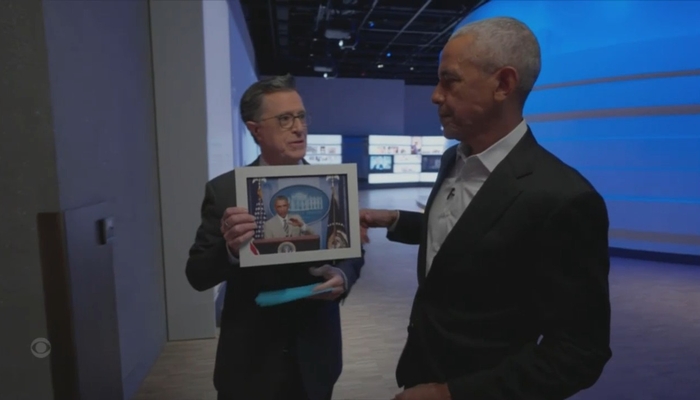
As CBS’s The Late Show prepares to wind down operations in less than three weeks, host Stephen Colbert traveled to Chicago for a lengthy interview with former President Barack Obama to hype the opening of his presidential library and museum. Amid a flurry of other softballs, Colbert would suggest that in contrast to President Trump, Obama was a pillar of executive restraint, and recall the old liberal idea that the worst thing Obama ever did was tear a tan suit.
One softball Colbert lobbed was, “Fifty to 100 years from now, when somebody comes to this center, what do you want them to take away from the experience? What do you want them to learn about you and the legacy of your administration?”
Stephen Colbert devoted most of Tuesday's show to an interview with former President Barack Obama where he asked such questions as "50 to 100 years from now, when somebody comes to this center, what do you want them to take away from the experience? What do you want them to learn… pic.twitter.com/SAogMclvRZ
— Alex Christy (@alexchristy17) May 6, 2026
Obama gave a generic-sounding response of, “I want them to put my presidency in context, right? I assume in my eulogy somewhere it will be mentioned that he was the first African American president. But what I want people to understand is that there was this extraordinary journey this country took to get to that point, and I was an episode in that… And if I do that, then 50 years from now when people come, presumably they'll still be inspired by that story. Not mine alone, but ours.”
Colbert then moved on, “There's often a conversation about the restriction or the need to restrict certain executive powers. I might have asked you this when you were running for president back in the day. Like, is there any power that President Bush has taken that you would say, ‘No, I don't want that power,' because it keeps accumulating. Now that you're no longer in office, what powers do you believe the president should not have?”
The man who was always bragging about his pen and phone and threatening, “If Congress doesn’t act, I will,” replied, “There are a couple that I followed even though they were law. And I want us — we're going to have to do some work to return to this basic norm, and we probably now have to codify it. The White House shouldn't be able to direct the attorney general to go around prosecuting whoever the president wants prosecuted.”
Next, Colbert acts as if Obama was a great pillar of executive restraint, "I might have asked you this when you are running for president back in the day. Like, is there any power that President Bush has taken that you would say, “No, I don't want that power” because it keeps… pic.twitter.com/p3Vmhb7k2X
— Alex Christy (@alexchristy17) May 6, 2026
He also claimed, “The idea is that the attorney general is the people's lawyer. It's not the president's consigliere.”
What about a wingman? Again, any reference to the IRS and Tea Party was conveniently ignored as Obama rolled on, “There's a bunch of stuff that, you know, we can overcome. We can't overcome the politicization of the criminal justice system. The awesome power of the state. You can't have a situation where whoever is in charge starts using that to go after their political enemies or reward their friends, right?... I would consult with Eric Holder, with my attorney general, all the time, around broad policy issues, but that's different than who do you charge, what case do you bring?”
When current Defense Secretary Pete Hegseth talks about woke-ism in the military, the Obama era stands out. Nevertheless, Obama added, “The second thing is the military. Don't politicize our military. As president, you are commander-in-chief. You are responsible for directing our military. But there had been a whole series of norms that were in place to ensure that you weren't trying to make that military loyal to you as opposed to the constitution and the people of the United States. We're going to have to find mechanisms to restore that.”
Later, the duo went on a tour of the museum, and Colbert sarcastically wondered, “Is there a wing dedicated to greatest blunders? Is the tan suit here? I’m asking if the tan suit is here.”
Later, Obama gives a tour of the museum, which leads Colbert to wonder "Is there wing dedicated to greatest blunders? Is the tan suit here?" pic.twitter.com/1ifpC7HBrE
— Alex Christy (@alexchristy17) May 6, 2026
After Obama declared that “I own that suit proudly,” Colbert pulled out a photo and wondered, “We have this if you want to put it on display someplace. A shattered nation looked up and saw that. When you look back at the tan suit, what occurs to you?”
Obama simply wondered, “Why?”
The real “why?” is why do Colbert and media types insist that the tan suit was the most controversial thing Obama ever did?
Here is a transcript for the May 5 show:
CBS The Late Show with Stephen Colbert
5/5/2026
11:55 PM ET
STEPHEN COLBERT: Fifty to 100 years from now, when somebody comes to this center, what do you want them to take away from the experience? What do you want them to learn about you and the legacy of your administration?
BARACK OBAMA: Well, look. I want them to put my presidency in context, right? I assume in my eulogy somewhere it will be mentioned that he was the first African American president.
COLBERT: I will say something about that.
OBAMA: But what I want people to understand is that there was this extraordinary journey this country took to get to that point, and I was an episode in that. And it's the struggle between the idea that “we the people” includes everybody, that it's not just some. It's not just some select few. So, what I want people to do when they come to this museum is to say, “This is part of that American story, that better story.” The one that has inspired not just generations, but also the world, and the Obama presidency was a part of that story. It was one small chapter. And if I do that, then 50 years from now when people come, presumably they'll still be inspired by that story. Not mine alone, but ours.
COLBERT: Yes, the good future isn't one where they say "Oh, we totally know what he means."
OBAMA: Yes.
COLBERT: The bad future is “What's he talking about?” There's often a conversation about the restriction or the need to restrict certain executive powers.
OBAMA: Yes.
COLBERT: I might have asked you this when you were running for president back in the day. Like, is there any power that President Bush has taken that you would say, “No, I don't want that power,” because it keeps accumulating.
OBAMA: Yeah.
COLBERT: Now that you're no longer in office, what powers do you believe the president should not have?
OBAMA: Well, there are a couple that I followed even though they were law. And I want us — we're going to have to do some work to return to this basic norm, and we probably now have to codify it. The White House shouldn't be able to direct the attorney general to go around prosecuting whoever the president wants prosecuted.
COLBERT: Right, because technically it’s under the executive branch.
OBAMA: Technically—
COLBERT: The norm is that it's independent.
Mr. Obama: The idea is that the attorney general is the people's lawyer. It's not the president's consigliere.
Stephen: Right, even when it's Bobby Kennedy.
OBAMA: --Bobby Kennedy. And so, two of the core principles of a democracy and we can survive a lot. Bad policy, funky elections. There's a bunch of stuff that, you know, we can overcome. We can't overcome the politicization of the criminal justice system. The awesome power of the state. You can't have a situation where whoever is in charge starts using that to go after their political enemies or reward their friends, right? So another power maybe I would say, although this is in the constitution, it's harder to change, but maybe don't pardon people who have given you a bunch of campaign contributions. Or invested in your businesses. So, restoring some sense of the Justice Department being independent in making judgments about specific cases and prosecutions.
I would consult with Eric Holder, with my attorney general, all the time, around broad policy issues, but that's different than who do you charge, what case do you bring?
The second thing is the military. Don't politicize our military. As president, you are commander-in-chief. You are responsible for directing our military. But there had been a whole series of norms that were in place to ensure that you weren't trying to make that military loyal to you as opposed to the constitution and the people of the United States. We're going to have to find mechanisms to restore that. And then, you know, a good policy that I'd like to see followed is that the president of the United States shouldn't have a bunch of side hustles that various companies and foreign entities can invest in.
…
COLBERT: Is there a wing dedicated to greatest blunders? Is the tan suit here? I’m asking if the tan suit is here.
OBAMA: Listen, I own that tan suit proudly, brother.
COLBERT: We have this, if you want to put it on display someplace.
OBAMA: I mean, I look great.
COLBERT: A shattered nation looked up and saw that.
OBAMA: Yeah. Yeah.
COLBERT: When you look back at the tan suit, what occurs to you?
OBAMA: Why?
from Newsbusters - Welcome to NewsBusters, a project of the Media Research Center (MRC), America’s leading media watchdog in documenting, exposing Follow News Busters
Red Pill Pharma A psychological pharmaceutical that unlocks logic and reason offering a second chance at individualism.

Sourced by the Find us on telegram. Real News for Patriots of the United States of America. We share content that re-affirms our soulful connection to light, Truth, and the Constitutional God given rights of Freedom and Liberty.




No comments