

PBS Soft-Pedals Radical Michigan Dem Abdul El-Sayed, Just a Waterskiing 'Normal Guy' #Political
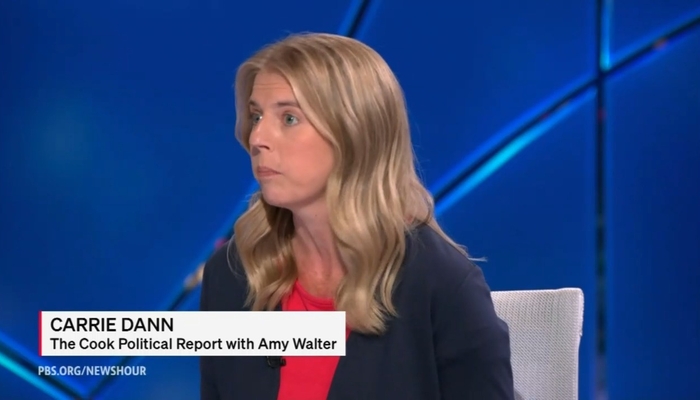
After Monday’s PBS News Hour dealt with breaking news about the red-flag festooned Democrat Graham Platner suspending his campaign for U.S. Senate in Maine (he would later drop out), guests Tamara Keith of NPR and Carrie Dann representing the Cook Political Report in place of Cook’s usual News Hour representative Amy Walter, who was out for the week.
Dann, who previously reported from D.C. for NBC News, proved more partisan than Walter, chirpily optimistic on the prospects of radical Abdul el-Sayed, who’s running for the Democratic nomination for U.S. Senate in Michigan.
Dann answered Nawaz’s question about what the race revealed “about the direction of the Democratic Party” by pushing El-Sayed as a normal guy with “progressive ideas.”
No one on the panel got into the devilish details of El-Sayed’s “progressive ideas,” like his deleted tweets calling for defunding the police and his documented hostility toward Israel, or lies about his potential Republican campaign opponent that even the notoriously slanted “fact-checkers” at PolitiFact managed to notice. Also, El-Sayed had been endorsed by popular left-wing streamer Hasan Piker, a hateful radical who has argued that America deserved 9/11.
The segment ended with a cheap shot at Trump unrelated to partisan politics, a viral photo taken on the DC Metro.
While Keith answered neutrally, Dann dredged up the white supremacy rally in Charlottesville (the details of which have recently been contested after revelations about funding from the scaremongering Southern Poverty Law Center). Dann wondered why the photograph non-story wasn’t a bigger actual story, and blamed Trump for pushing U.S. politics far to the right.
PBS News Hour
7/6/26
7:36:50 p.m. (ET)
Amna Nawaz: Let's start with this late breaking news now happening in Maine.
Carrie, we were already seeing some Democrats start to come out and call for Platner to step down and step out of the race. What do you think is going to happen here?
Carrie Dann: Well, look, I have never seen a candidate make a video like that saying, I'm going to assess the situation, move forward, and go on to say, actually, I'm going to stick this one out. It looks like this is trending towards him making the decision to drop out.
Now, the timing is really important here. If this story had broken after 5:00 next Monday, Democrats would have been stuck with Graham Platner on the ballot. As it stands, he has a week to drop out, and then, if he chooses to, the party can choose another candidate within the next two weeks.
Who they choose, if he is to drop out, is going to be really crucial here. I think, if you're Democrats, you want to pick the most generic Democrat you possibly can for that seat. Now, the Maine governor's race just took place. There are candidates who ran statewide there, as well as other candidates who ran for Senate, who are probably raising their hands to maybe want to be that candidate on the ballot.
Susan Collins remains very vulnerable. This could end up being the best news Democrats could have had if they are able to replace him with a candidate who can be competitive against her. However, that person is going to have to raise a lot of money and a lot of name I.D. really darn fast.
Amna Nawaz: Tam, how are you looking at this?
Tamara Keith, National Public Radio: Yes, I mean, Platner took that primary by storm. He got voters very excited about him and his progressive policies. And then there's just been this drip, drip, drip of controversies, scandals, red flags leading up to this point, where we have seen Democrats start to separate themselves from him, including people who were early to endorse him.
Ro Khanna, who is a progressive Democrat and congressman, has said, ugh, that's a little bit too far. So has Ruben Gallego, a senator. And more are coming. This is -- this is just one of those things where it becomes insurmountable.
And, as Carrie said, he said that he's taking time to reflect on the best path forward. That is not what you say if you're fighting and staying in.
Amna Nawaz: Meanwhile, I know you're also tracking another big race in Michigan. This is the Democratic Senate primary race, a big moment this weekend when one of the candidates, Mallory McMorrow, decided to drop out.
The race is now down to two people. There's a centrist candidate in Haley Stevens, and a progressive candidate in Abdul El-Sayed.
Tam, as you know, this is a state that Trump narrowly won in 2024 after flipping it in 2016. So the Dem winner here will likely face Republican Mike Rogers. What do you take away from all of this?
Tamara Keith: Yes, I think that what we are watching with this race and have been watching, and now it'll become an even sort of clearer example of this, is, where is the heart of the Democratic Party? What do Democratic primary voters want, not just in very blue places like Denver and New York City, but also in a purple state like Michigan?
And what you had was this progressive lane and you had the more conventional Democratic standard lane, whatever you want to call it. And Mallory McMorrow was competing with Congresswoman Stevens in that more mainstream, mainline Democratic lane.
And McMorrow -- I talked to someone who has worked with her. McMorrow just couldn't compete. Stevens had a ton of money, a ton of backing from the Democratic establishment, and McMorrow couldn't get her name I.D. out there.
I will note she has not endorsed. She has not thrown her support behind either of them. And I think that there's a real question of where her supporters go, because, certainly, some of the people who told pollsters they were supporting her, they wanted change. They just wanted a different flavor of change.
Amna Nawaz: Yes.
Tamara Keith: And I think that trying to figure out this -- how to capture the energy that a lot of Democratic and, frankly, Republican voters have for change, I think is a theme that we're seeing in all of these races.
Amna Nawaz: Well, this is the question we ask over and over again, Carrie. Does this race tell us anything about the direction of the Democratic Party?
Carrie Dann: I think it certainly will.
And I think Abdul El-Sayed -- I do think Michigan Democratic voters are thinking about electability as part of their calculation here. El-Sayed makes the argument: I can remake the electorate. I am -- with progressive ideas, with the backing of somebody like Bernie Sanders, I can mobilize young progressives. I can mobilize disaffected Trump voters who liked Trump because they were voting for change.
He represents certainly bold change. I think it's interesting that McMorrow was not able to get that momentum, because she was sort of this Goldilocks candidate. If you're thinking about electability and you also want bold change in somebody who says, hey, I'm going to tell Chuck Schumer that I don't support him, she would have been that candidate, but she just simply couldn't compete.
El-Sayed, on the other hand, seems to have the momentum. He's being outspent on the airwaves by Haley Stevens by 17-1. So the support that he is getting is really from the grassroots movement that he has been able to build and also I think from being a talented candidate. Policy aside, he communicates -- I think he looks and sounds like a normal person and is calling for change.
And I think that's what a lot of voters want in their politicians. He does these great -- he does these advertisements where he's waterskiing.
Carrie Dann: I mean, he looks like a normal guy. People -- that may be appealing to people.
Amna Nawaz: Before I let you both go, I need to kind of look back at this weekend's 250th celebrations and a bit of a split screen I know you have both been mulling over as well, because we saw the president speak, as he often does, sort of marrying historical narratives with political grievances in his remarks.
And then we also saw these marches that caught a lot of attention, which was members of this white nationalist group the Patriot Front marching through the streets of Washington, D.C., chanting "Reclaim America. "
I know a lot of people saw this photo that went viral of a Black woman on a train surrounded by these people. This was taken by photographer Cheney Orr.
Tam, what does all of this say to you about America at 250?
Tamara Keith: Yes, America in 2026 is still a very complicated country that doesn't have just one red, white, and blue narrative, but it has a lot of competing ideas, and the idea that it is still working towards being a more perfect union.
Amna Nawaz: Carrie?
Carrie Dann: And when you talk about that video of this white supremacist group, I think it just is a reminder of how much the Overton window has moved on this.
Recall the Charlottesville Unite the Right Rally, how horrifying that was for Americans, because they were so unused to people being so brazen about those views. Now, this happened on a very busy weekend otherwise. But still it was sort of a tertiary story, and I think that just shows you how much the country has changed over this period of time of Donald Trump's presidency.
Amna Nawaz: Complicated, as you say, but hopefully on her way to a more perfect union.
Carrie Dann, Tamara Keith, great to see you both. Thank you.
Tamara Keith: You're welcome.
Carrie Dann: Thank you.
from Newsbusters - Welcome to NewsBusters, a project of the Media Research Center (MRC), America’s leading media watchdog in documenting, exposing Follow News Busters
Red Pill Pharma A psychological pharmaceutical that unlocks logic and reason offering a second chance at individualism.

Sourced by the Find us on telegram. Real News for Patriots of the United States of America. We share content that re-affirms our soulful connection to light, Truth, and the Constitutional God given rights of Freedom and Liberty.



No comments